By Hebrews Pouyeli Kumako
President John Dramani Mahama has outlined far-reaching reforms in agriculture and education as part of his government’s broader national reset agenda, aimed at accelerating development, boosting food security, and improving access to quality education.
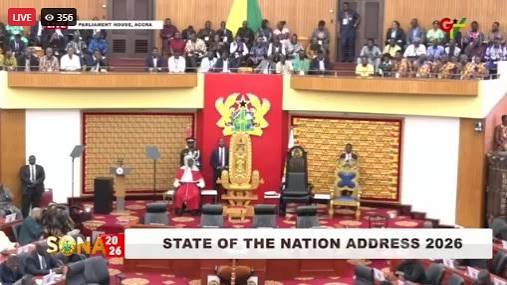
Delivering the State of the Nation Address (SONA), monitored by News Volta on February 27, 2026, the President announced major investments in irrigation, agro-industrialization, youth employment, and educational infrastructure across the country.
Massive Boost for Agriculture and Food Security
President Mahama revealed that schools across the Northern Belt and Bono-South Regions are now benefiting from agricultural interventions designed to enhance food production and nutrition.
Key irrigation schemes, including JEA, Weta, Tano-South, Bung, Ashaiman, and Abayime, are currently undergoing rehabilitation, while new inland valleys covering over 1,300 hectares are being developed to expand rice cultivation.
Under the Global Agriculture and Food Security Programme, government has launched a $20 million agro-input distribution project targeting 15,000 farming households, including 30,000 women and youth, across 12 districts in six regions within the northern savannah ecological zone.
The project supports the production of maize, rice, soya bean, cowpea, and groundnuts, while promoting year-round vegetable farming through solar-powered micro-irrigation systems. It also includes backyard and commercial poultry production, as well as the distribution of fertilizers and certified seeds to strengthen the poultry value chain.
Modernization Through Farmer Service Centers
To modernize agriculture, procurement is underway for 660 tractors, 400 combine harvesters, and other farming machinery. Construction of 11 farmer service centers will begin this year, offering affordable access to land preparation, harvesting, storage, extension services, input supply, and equipment leasing, especially for smallholder farmers.
The President announced that the first farmer service center will be inaugurated at Afram Plains within the next two weeks.
Youth Empowerment and Extension Services
To strengthen extension services, 540 motorbikes have been procured, with 150 already distributed. Government is also employing 400 Chief District Coordinators nationwide, while 10,000 young Ghanaians are being enrolled under the four-year National Service Agripreneur Programme, with 3,000 already posted.
Agro-Industrial Drive and Value Addition
Government is placing farmer cooperatives at the center of agricultural transformation. As of October 2025, 70,000 community-based farmer cooperatives have been formed nationwide.
A flagship project under the agro-industrial drive is the $154 million Ghana–Italy partnership, aimed at developing a 10,000-hectare irrigation model farm for the production of rice, maize, soya, and tomatoes — all for local consumption.
Additional projects include:
- Rice processing plants in Upper East and Upper West
- Poultry feed factories in Ashanti
- Cashew and onion processing plants in Bono East
- A 40-ton-per-day soya processing plant in Northern Ghana
Poultry Sector Revitalization
To cut Ghana’s $300–$400 million annual poultry import bill, government launched the Poultry Farm-to-Table Project, targeting 10 million birds annually through commercial, SME, and backyard poultry schemes. The NKUKONKITENTIKITI programme, focused on women and youth, aims to reach 60,000 households nationwide.
Major Education Sector Reforms
President Mahama reported significant progress in education, including:
- Over 152,000 first-year tertiary students benefiting from the No-Fees-Threshold initiative, with projections of 220,000 beneficiaries
- Extension of the Student Loan Scheme to law students
- Free tertiary education for Persons with Disabilities (PWDs) now fully implemented
- Stable feeding for all Free SHS students in 2025
Parliament also passed major education laws, including:
- KNUST Bill 2025
- Ghana Scholarships Authority Bill 2025
- Change of University Names Bill 2025
- University for Development Studies Bill 2025
- GETFund Amendment Bill 2025
Massive Investment in Basic Education
To address infrastructure deficits, government has programmed the construction of:
- 200 Kindergarten blocks
- 200 Primary school blocks
- 200 Junior High Schools nationwide
The President further announced the full clearance of all capitation grant arrears and BECE registration subsidy debts, easing financial pressure on public basic schools.
Digital Skills and AI Education
Government is reviewing the standard-based curriculum to introduce robotics, coding, and artificial intelligence education from an early age, emphasizing ethical use, critical thinking, and digital responsibility.
Commitment to Inclusive Education
Under the amended GETFund Act, a sustainable funding framework has been established to implement free education for learners with special needs beginning in the 2026 academic year. Additionally, the daily feeding grant for students in special schools has been increased.
President Mahama reaffirmed his administration’s commitment to fulfilling its manifesto promises, emphasizing that agriculture and education remain the twin pillars of Ghana’s national transformation agenda.
Source News Volta I Monitoring Desk